Nucleic Acid Labelling & Retention
Investigate DNA and RNA in their spatial context. Explore anchoring chemistry that supports nucleic acid retention for imaging in expanded samples.
Keeping molecular information in place
The organisation of DNA and the location of RNA help researchers investigate how genetic information is arranged and used within cells. Imaging adds this spatial perspective, connecting molecular signals with the cellular structures around them.
Expansion microscopy creates more physical separation between retained targets. For nucleic acid imaging, this requires a strategy that carries DNA or RNA through sample processing while keeping it connected to the expanding hydrogel.
Nucleic acid-reactive anchoring chemistry introduces that connection by modifying the molecules and providing a polymerisable group for gel incorporation. Detection is then planned around the question being asked, using a staining or probe-based method compatible with the preparation. Together, retention and detection determine which molecular information becomes visible in the expanded sample.

Why choose Chrometra?
Chemistry directed at nucleic acids
Nucleic acid-reactive anchoring chemistry provides a route for modifying endogenous DNA and RNA before hydrogel formation.
Retention at the target
Covalent hydrogel attachment supports retention of the nucleic acids themselves, providing a foundation for subsequent imaging.
Detection planned separately
Anchoring establishes the gel connection, allowing the staining or detection step to be selected for the intended molecular readout.
Reagents for nucleic acid labelling & retention
Explore reagents for preparing and anchoring nucleic acids within your expansion microscopy workflow.
Explore related applications
See how anchoring supports imaging questions centred on protein localisation and the spatial organisation of nucleic acids.
Protein & Antibody Labelling
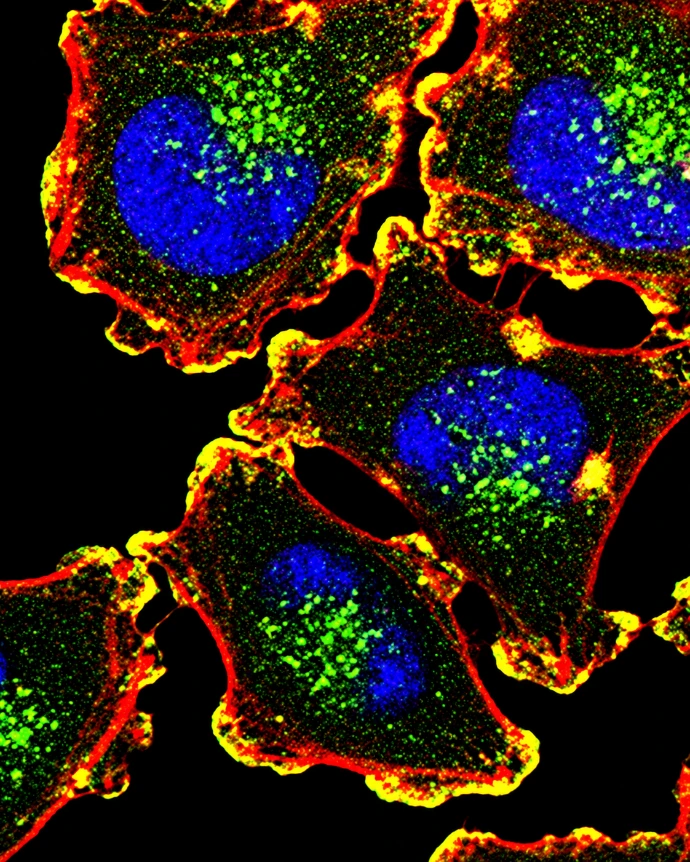
Prepare protein and antibody labels with chemistry for conjugation, fluorescent detection and incorporation into the expansion gel.
Biomolecule Anchoring & Retention
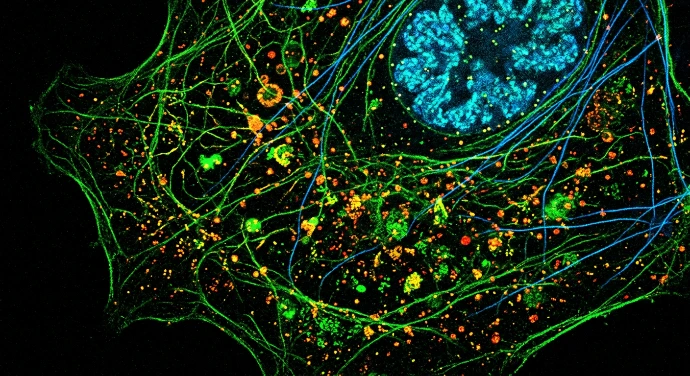
Explore how anchoring chemistry is selected for different biological molecules and the reactive groups available for modification.
Let's talk about your experiment
Tell us about your work and what you’d like to achieve. We’re here to answer your labelling questions and help you choose the right reagents. We'd love to hear from you!